What's in the Water? The Hidden Ingredient Behind Ataşehir's Legendary Breads and Börek
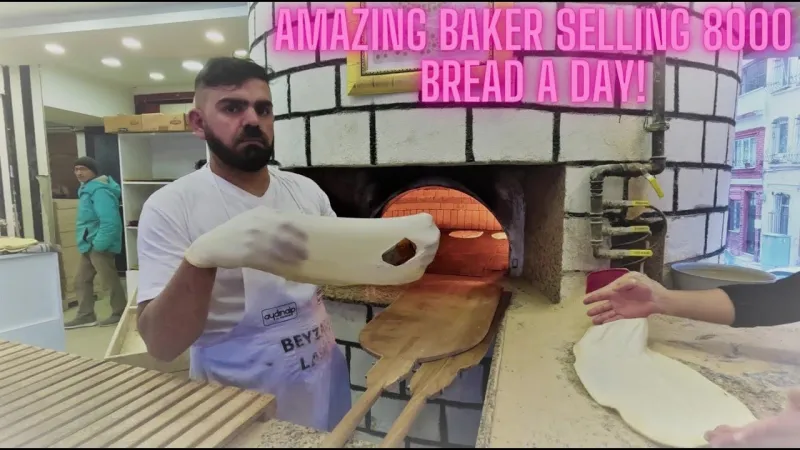
Photo: Turkish baker kneading dough traditional bakery Istanbul mineral water, via i.ytimg.com
Ask a baker in Ataşehir why their simit has that particular chew — that satisfying resistance before it gives way to a soft, sesame-fragrant interior — and they'll probably shrug. "It's the water," they'll say, almost dismissively, as if this explains everything. And honestly? It kind of does.
Water is one of those ingredients that American home bakers almost never think about. We measure flour, weigh butter, obsess over proofing times. But water? We just turn on the tap. In Ataşehir, though, water isn't an afterthought. It's a living part of the recipe.
A District Built on Springs
Ataşehir sits on the Asian side of Istanbul, and beneath its urban surface runs a geological story that most residents — let alone visitors — never hear. The district is underlaid with a network of mineral springs that have been feeding local wells and fountains for centuries. These aren't dramatic geothermal features. They're subtle, quiet, and easy to overlook. But their chemical fingerprint is unmistakable in the food.
The water that comes up through these springs tends to be moderately hard, carrying dissolved calcium and magnesium bicarbonates at levels that meaningfully affect gluten development. For bread bakers, this matters enormously. Harder water strengthens gluten networks, producing a tighter, more elastic dough that holds its shape under heat. The result is bread with structure — loaves that don't collapse into dense bricks, and börek layers that stay distinct rather than merging into a soggy mass.
Sultana Hanım, a third-generation baker who runs a small pastry counter near the Küçükbakkalköy market, puts it plainly: "My grandmother never moved her operation, not once. People asked her why she didn't open somewhere bigger, somewhere central. She always said the same thing — if I move, the börek moves with me, but the taste doesn't."
The Chemistry Nobody Taught in Culinary School
Here's where it gets genuinely interesting for anyone who loves baking science. Water hardness affects yeast activity, too. Moderate mineral content provides trace nutrients that feed wild and commercial yeasts alike, supporting a more vigorous, consistent fermentation. Overly soft water, by contrast, can make dough slack and sticky, while extremely hard water can actually inhibit fermentation by tightening gluten too aggressively.
Ataşehir's springs seem to hit a sweet spot — and local bakers have been calibrating their recipes around that sweet spot for so long that the formulas themselves have evolved to depend on it. The hydration ratios, the resting times, the baking temperatures — all of it has been quietly tuned to water that most of the world doesn't have access to.
This is why, if you've ever tried to recreate a börek recipe from an Istanbul cookbook and found it coming out slightly wrong — a little too dense, a little less flaky — you weren't doing anything wrong. You were just using different water.
What the Bakers Won't Tell You (Until They Will)
There's a protective streak among Ataşehir's older bakers when it comes to their water sources. A few still draw from private wells on their properties, a practice that's increasingly rare as the neighborhood has urbanized. One baker — who asked not to be named, which somehow made the conversation feel more dramatic than it probably needed to be — told us he fills large containers from a specific courtyard tap every morning before his shop opens. "I've tried the municipal water," he said. "The bread is fine. But it's not the same bread."
Fine but not the same. That's a distinction that matters in a city where food memory runs deep and customers notice.
Other bakers have adapted. Knowing they can't always access spring water, some have begun experimenting with mineral water additions — blending tap water with still bottled mineral water to approximate the hardness levels their doughs expect. It's a workaround, not a solution, but it speaks to how seriously these bakers take the variable.
Practical Notes for American Home Bakers
If you're baking Turkish breads or börek in the US, the good news is that you have more control over your water than you might think. Here are a few approaches worth trying:
Check your local water hardness. Most municipal water utilities publish annual water quality reports. If you're in a soft-water city like Seattle or Portland, your bread dough may behave differently than if you're in Phoenix or Chicago, where water tends to run harder. Knowing your baseline helps.
Experiment with mineral water. For a batch of simit or a sheet of su böreği, try replacing about half your tap water with a European-style still mineral water — something like San Pellegrino (without the carbonation, obviously) or a Turkish brand like Erikli if you can find it at a Middle Eastern grocery. The mineral content varies by brand, but most run harder than American municipal averages.
Don't skip the rest. Ataşehir bakers almost universally let their doughs rest longer than Western recipes suggest. Part of this is tradition, but part of it is that harder water needs more time to fully hydrate the flour. If your börek dough feels stiff, resist the urge to add more water — give it another fifteen minutes first.
Embrace imperfection. The honest truth is that your kitchen in Austin or Minneapolis will never produce an exact replica of what comes out of a wood-fired oven in Ataşehir. But that's not the goal. The goal is to understand why the original tastes the way it does — and then make something genuinely good with what you have.
Why This Matters Beyond the Kitchen
There's a broader cultural point underneath all the chemistry. Food geography is real. The reason certain wines taste like their region, certain cheeses can't be replicated outside their valleys, certain breads only fully make sense in their home neighborhoods — it's not mysticism. It's geology, hydrology, microclimate, and centuries of human adaptation to local conditions.
Ataşehir's bakers didn't set out to make water-dependent recipes. They set out to make the best bread they could with what they had. Over generations, the recipes and the place became inseparable.
For the Turkish diaspora in the US, that's both a source of longing and a point of pride. The food you grew up eating wasn't just the product of a recipe — it was the product of a place. And when you taste something close to it, even thousands of miles away, you're tasting a little bit of that place, too.
That's worth understanding. And worth the extra trip to the grocery store for a bottle of mineral water.
