Hidden Tables, Real Food: Inside Ataşehir's Secret Network of Home Cooks Keeping Ottoman Recipes Alive
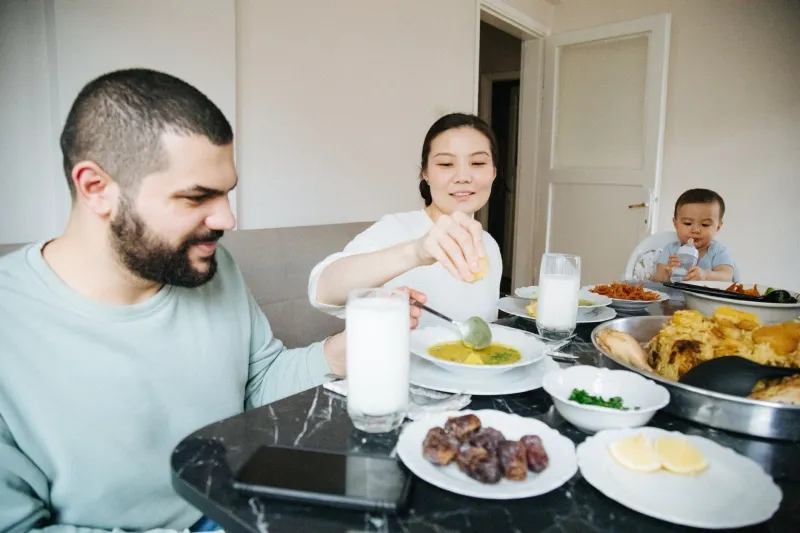
You won't find these places on Google Maps. There's no Instagram handle, no reservation system, no Yelp page. The address comes through a friend of a friend, passed along in a WhatsApp message that gets deleted after you've written it down. You show up at an apartment building in Ataşehir, take the elevator to the fifth floor, and suddenly — you're sitting at a table that smells like slow-cooked lamb and dried mulberries, surrounded by strangers who already feel like family.
This is Ataşehir's underground food network. And it's been running, quietly and deliberately, for longer than most people realize.
Not a Restaurant. Not Exactly a Dinner Party Either.
The informal food economy in Ataşehir exists somewhere between a supper club, a community kitchen, and a living archive. Home cooks — mostly women, mostly in their forties, fifties, and sixties — host small gatherings where the food on the table is the kind that doesn't survive commercialization. Dishes that take three days to prepare. Recipes that were never written down. Flavors that require ingredients sourced from specific vendors at specific times of year.
"A restaurant has to be consistent," explains Neriman Hanım, who has been hosting informal dinners in her Ataşehir apartment for nearly a decade. "I don't have to be consistent. I cook what's in season. I cook what my grandmother taught me. Some nights that's a lamb dish from Kastamonu. Some nights it's a dessert nobody under forty has even heard of."
Neriman isn't alone. Across Ataşehir, a loose constellation of home cooks, food traders, and culinary enthusiasts operates this way — sharing meals, swapping techniques, and quietly refusing to let certain recipes disappear.
Why It Matters That This Stays Underground
There's a reason these networks don't advertise. Part of it is regulatory — Turkey has its own complicated relationship with unlicensed food businesses. But the bigger reason is cultural. The moment something gets a price tag and a public-facing identity, it changes. The food changes. The conversation changes. The whole reason people gather changes.
"When I cook for a restaurant, I'm cooking for strangers who expect a product," says Cengiz, a former chef who now organizes informal food gatherings in the neighborhood. "When I cook for this group, I'm cooking for a community that expects honesty. Those are completely different things."
What Cengiz and others in the network have discovered is that food cooked outside commercial pressure tends to be more experimental, more regional, and more historically accurate. There's no incentive to simplify a recipe for mass appeal. If a dish takes forty-eight hours and an obscure spice blend, that's exactly how it gets made.
The Recipes That Only Live Here
Ask anyone in the network what they're most proud of preserving and the answers are specific, almost stubbornly so. One woman talks about a walnut-and-pomegranate stew that her family brought from the Black Sea coast three generations ago. Another describes a version of börek that uses a dough technique so labor-intensive that she's only met two other people who still make it.
These aren't dishes you'll find in a cookbook or a food blog. They exist because someone decided to keep making them — and because there was a community around them willing to eat, ask questions, and eventually learn.
That transmission — cook to guest to eventual cook — is the whole point. The supper club format, informal as it is, functions as a kind of culinary apprenticeship. You eat the dish. You ask how it's made. You come back and help prepare it. Eventually, you host your own gathering and teach someone else.
What the Turkish Diaspora in the US Can Take From This
For Turkish Americans, particularly those in cities like New York, Chicago, Los Angeles, or Houston where the community is large enough to support something like this, the Ataşehir model offers a genuinely replicable blueprint.
The barriers are lower than you might think. You don't need a commercial kitchen. You don't need a nonprofit structure or a formal cultural organization. You need a living room, a few people who care about food, and a willingness to cook something that takes longer than it probably should.
Several Turkish American community members we spoke with have already started doing exactly this. In Brooklyn, a group of women from Trabzon backgrounds gather monthly to cook and share dishes specific to that region. In Chicago, a more mixed group has been running informal Ottoman-inspired dinners for two years, rotating hosts and recipes each time.
"We started because we realized that the food we grew up eating didn't exist anywhere in Chicago," says Defne, one of the Chicago organizers. "Not in restaurants, not in cookbooks. The only place it existed was in our mothers' kitchens. So we built a space to keep making it."
The community-building that happens around these tables isn't incidental — it's the product. People who might otherwise have little connection to each other find common ground over a shared dish, a shared memory, a shared instinct that something worth preserving is slipping away.
The Logistics of Trust
Running an underground food network isn't without its challenges. Finding participants requires word-of-mouth, which means growth is slow and deliberate. Sourcing authentic ingredients in the US is harder than in Istanbul, where a specific spice trader or a particular variety of dried pepper is just a market trip away. And there's always the question of who gets invited — these gatherings work because they're intimate, and intimacy doesn't scale.
But the people doing it in Ataşehir, and increasingly in Turkish American communities across the US, seem to regard those limitations as features rather than bugs. The slowness is part of the point. The difficulty is what keeps it real.
"If it were easy, everyone would do it," Neriman says, laughing. "Then it would just be a restaurant."
A Table Worth Building
There's something quietly radical about the idea that the best way to preserve a culinary tradition is to keep it out of the marketplace entirely. No branding, no scaling, no optimization. Just people cooking for each other, passing down what they know, and trusting that the next person at the table will care enough to keep it going.
Atatürk Sofrası has always believed that the most important food stories aren't told in fine dining rooms or on cooking competition shows. They're told at kitchen tables, in apartments, over dishes that took all day to make and disappeared in under an hour.
Atatşehir's hidden tables are proof of that. And if you're part of the Turkish diaspora in the US and you're not already sitting at one — maybe it's time to set one up yourself.